Threat Hunting in Enterprise Networks
Your Enterprise Network Is Experiencing Suspicious Activity. Is It a Misconfiguration—or Is a Cyberattack Underway?
Meet REMI AI for Threat Hunting & Incident Response.
REMI Enterprise automatically analyzes exported logs and reports from endpoints, servers, identity platforms, firewalls, email, cloud services, and security tools. Its embedded AI correlates these records to reconstruct suspicious sign-ins, privilege escalation, malware execution, attack staging, lateral movement, and data transfers across your IT environment.
REMI traces how access occurred, which accounts and devices were involved, what changed, and how the incident unfolded. It links findings to the original evidence and delivers forensic reports, timelines, relationship diagrams, and a Cyber SITREP with prioritized recommendations for containment, investigation, and recovery—all processed locally and fully offline.
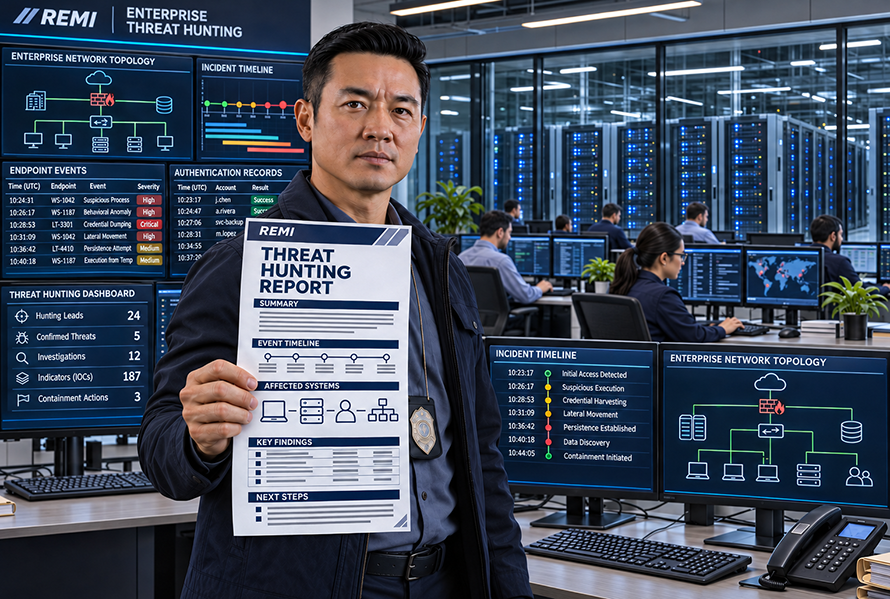
REMI combines proactive threat hunting with post-attack forensic reconstruction.
-
Apex Threat Hunting
Drop your mixed-vendor event logs and security alerts into REMI to hunt for suspicious activity across your environment. Its AI analyzes behaviors, correlates related events, and examines surrounding activity for signs of unauthorized access, staged malware, persistence, and unusual communications. The resulting report explains what the evidence supports and what needs further investigation.
-
Post Attack Reconstruction
After a suspected attack or disruption, REMI connects the recorded activity into a chronological forensic narrative explaining what happened and how it unfolded. It traces access, execution, configuration changes, file activity, and network connections back to their supporting records. A forensic report, timeline, and Cyber SITREP document the findings, recommended next steps, and unresolved questions—all generated locally and fully offline.
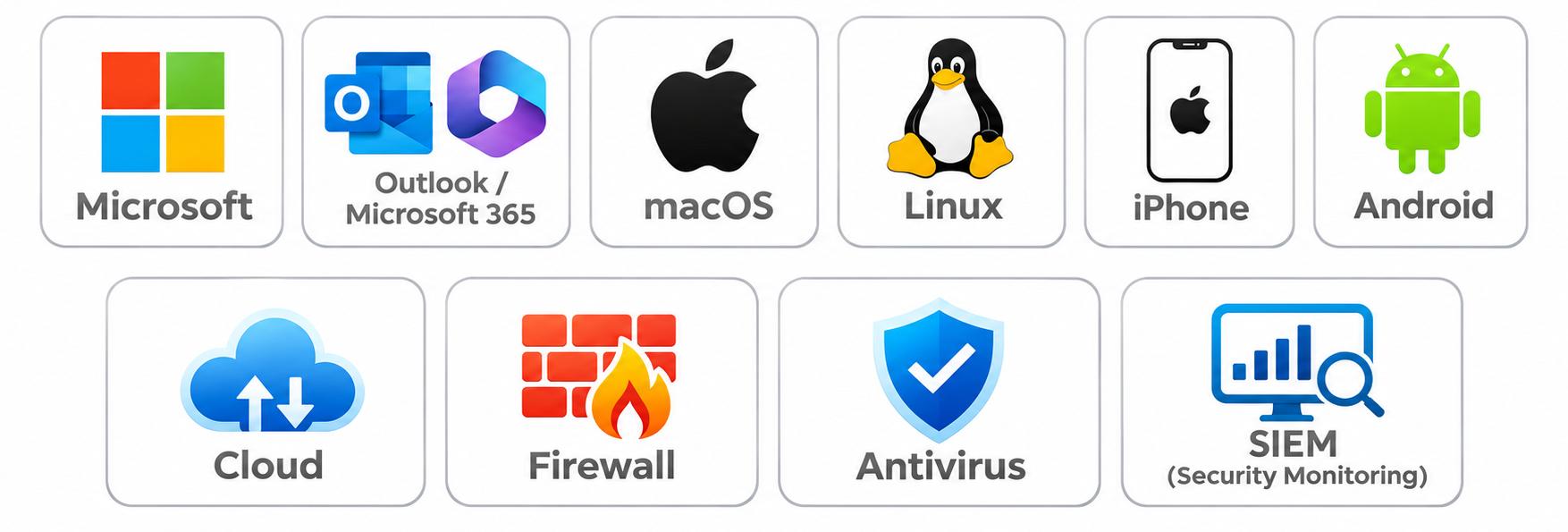
REMI imports, aggregates, and normalizes native exported event logs across vendors and platforms, giving you a broader view of what happened and what devices were involved.
REMI Enterprise ingests exported records from endpoints, servers, identity platforms, firewalls, VPNs, email, cloud services, and security tools. Its automated AI pipeline brings these sources together to reconstruct suspicious access, privilege changes, process execution, lateral movement, and data transfers across your IT environment.
As records move through the pipeline, REMI normalizes their different formats into a unified dynamic schema—aligning timestamps, field names, accounts, device identifiers, and event details while preserving references to the original evidence.
REMI correlates activity across platforms and vendors, identifies affected accounts and systems, and generates forensic reports, evidence-linked timelines, relationship diagrams, and a Cyber SITREP with prioritized next steps for containment, investigation, and recovery. Everything runs locally and fully offline.
✅ Ingest mixed enterprise IT logs and reports
✅ Normalize records into a unified dynamic schema
✅ Correlate identities, endpoints, and network activity
✅ Reconstruct an evidence-linked incident timeline
✅ Generate forensic reports, diagrams, and a Cyber SITREP
-
Endpoints, Identity & Network Systems
| Endpoints and workstations |
Staff PCs, laptops, and administrator workstations; operating-system events, sign-ins, process execution, and local security records where available. |
| Servers and storage |
Windows and Linux servers, file shares, and storage platforms; administrative activity, service changes, scheduled tasks, and file-access records. |
| Identity and authentication |
Active Directory, Entra ID, single sign-on, and multifactor authentication; sign-ins, account creation, authentication failures, and group membership changes. |
| Privileged access and service accounts |
Administrative identities, service accounts, and privileged-access platforms; elevated sessions, role changes, credential use, and permission updates. |
| Network devices and wireless |
Routers, switches, wireless controllers, access points, and network access controls; device connections, port events, administrative access, and configuration changes. |
| Firewalls and network security |
Perimeter and internal firewalls, intrusion detection/prevention, and network sensors; connection records, blocked traffic, alerts, and rule changes. |
| VPN and remote access |
VPN gateways, remote desktop services, jump servers, and remote support tools; authentication, session activity, and file transfers where recorded. |
| DNS, DHCP, and address assignment |
DNS queries, DHCP leases, and address-management records; domain lookups and time-based associations between devices and network addresses. |
| Web proxies and gateways |
Web proxies, secure web gateways, and reverse proxies; requested destinations, connection outcomes, downloads, and filtering events where logged. |
| Certificates and device trust |
Certificate authorities, enrollment services, and device-trust platforms; certificate issuance, revocation, authentication, and trust-policy changes. |
| Mobile devices and management |
Managed phones, tablets, and device-management platforms; enrollment, compliance events, application deployment, and administrative actions. |
| Removable media and local transfers |
USB device connections, removable-storage controls, and local transfer records; device identifiers, access activity, and file movement where captured. |
Scroll to view more endpoint, identity, and network systems ↓
-
Cloud, Applications & Security Tools
| Cloud infrastructure |
Cloud accounts, subscriptions, virtual networks, and compute resources; management activity, access events, resource creation, and configuration changes. |
| Cloud storage and file sharing |
Object storage, hosted file services, and document-sharing platforms; uploads, downloads, deletions, permission changes, and external sharing where recorded. |
| Email and mailbox activity |
Mail servers, cloud mailboxes, and email security gateways; message tracing, mailbox access, forwarding rules, delegated permissions, and filtering events. |
| Collaboration and SaaS applications |
Messaging, meeting, productivity, and business platforms; sign-ins, administrative actions, application integrations, and content-sharing activity. |
| Business applications and databases |
Application servers, database platforms, and integration services; access records, queries, scheduled jobs, data changes, and administrative events where audited. |
| Web applications and API services |
Web servers, application gateways, APIs, and web application firewalls; requests, authentication events, errors, blocked activity, and configuration changes. |
| Endpoint detection and protection |
Antivirus, endpoint detection and response, and application-control platforms; detections, process trees, quarantine actions, and security-policy changes. |
| SIEM and security monitoring |
Security information and event management platforms, log collectors, and alert services; aggregated events, detection results, case records, and collection-status changes. |
| Data protection and transfer monitoring |
Data-loss prevention and transfer-monitoring platforms; policy violations, sensitive-data alerts, blocked transfers, and sharing events where available. |
| Virtualization, containers, and orchestration |
Hypervisors, virtual machines, container platforms, and orchestration services; administrative actions, workload creation, execution events, and configuration changes. |
| Code, secrets, and deployment |
Code repositories, build servers, deployment pipelines, and secrets-management services; commits, builds, deployments, credential access, and permission changes. |
| Backups and recovery |
Backup servers, cloud backup services, repositories, and recovery consoles; job histories, restores, retention changes, and deletion activity. |
| Incident cases and response records |
Exported incident tickets, investigation notes, security alerts, and response-action histories; recorded findings, timestamps, and containment actions. |
Scroll to view more cloud, application, and security sources ↓
The AI model is trained to recognize the behaviors and patterns of hundreds of cyber tradecraft activities within your exported event logs
Recognizing adversarial behaviors and patterns
REMI’s AI model examines exported event logs for behaviors and patterns associated with hundreds of adversarial cyber activities. It analyzes records from different vendors and platforms together, looking for signs that may warrant further investigation.
✅ Identify suspicious login and access activity
✅ Examine process and script execution
✅ Look for persistence and concealment behaviors
✅ Detect unusual configuration or privilege changes
✅ Identify potential data staging and transfer activity
✅ Flag behaviors for further correlation and investigation

REMI’s advanced correlation analysis model connects flagged activity to user sessions, computer names, and accounts, beginning the forensic reconstruction of what happened and how it unfolded.
REMI correlates flagged activity across mixed-vendor IT event logs and security alerts, connecting accounts, user sessions, computers, processes, files, and network communications. It examines surrounding events to trace how suspicious access relates to execution, privilege changes, persistence, staged files, and external connections.
These relationships begin the forensic reconstruction of how an incident unfolded. Each connection retains its supporting source records, while missing or ambiguous links become targeted follow-up questions—all processed locally and fully offline.
✅ Connect flagged activity to accounts, devices, and sessions
✅ Correlate remote access with process and script execution
✅ Link configuration changes, persistence, and staged files
✅ Trace related activity across hosts and network connections
✅ Preserve the source evidence supporting each relationship
✅ Identify gaps requiring additional evidence or verification

REMI thinks like an investigator—explaining what the timeline’s evidence confirms, what remains unresolved, and which additional event logs are needed to fill the gaps.
REMI examines the incident timeline and supporting event logs to explain what happened, how events connect, and what the evidence supports. It uses surrounding activity to provide context, evaluates possible explanations, and separates confirmed findings from relationships that still require verification.
When the records leave unanswered questions, REMI identifies the gaps and recommends specific additional logs—such as authentication, endpoint, firewall, DNS, or application records—to investigate them. The resulting narrative connects findings to their source evidence and gives responders a clear path for further investigation.
✅ Explain what the available evidence confirms
✅ Distinguish supported findings from possible explanations
✅ Use surrounding events to clarify the sequence
✅ Identify unresolved relationships and missing context
✅ Generate targeted investigative follow-up questions
✅ Recommend additional event logs needed to close the gaps

See how REMI’s capabilities support investigative objectives described in federal logging policy and joint CISA, FBI, and NSA guidance.
AI-powered threat hunting that supports federal investigative objectives
REMI brings exported IT and OT event logs together for automated behavioral analysis, correlation, and forensic reconstruction. Its AI hunts for suspicious activity across vendors and platforms, connects related events, and explains the findings in a chronological, evidence-linked narrative.
These capabilities support the threat hunting, investigation, response, and forensics objectives described in OMB Memorandum M-26-14, alongside the behavioral analysis and cross-source correlation practices recommended in joint CISA, FBI, NSA, and international guidance.
✅ Combine multiple sources — analyze mixed-vendor, cross-platform event-log exports together
✅ Hunt for adversarial behaviors — examine suspicious access, execution, persistence, and configuration changes
✅ Connect related activity — correlate accounts, sessions, devices, processes, files, and network communications
✅ Reconstruct attack patterns — organize connected events into an evidence-linked timeline
✅ Explain the findings — distinguish confirmed activity from possible explanations and unresolved relationships
✅ Direct further investigation — identify missing evidence and recommend additional logs
✅ Support response planning — generate forensic reports and a Cyber SITREP with recommended next steps
✅ Analyze sensitive records offline — process imported evidence locally
REMI supports these investigative objectives; meeting all federal requirements also depends on the agency’s logging, retention, security controls, and operating procedures.
Government customers need more than stored records. They need to bring evidence together, map attack patterns, and reconstruct activity after a known or suspected compromise.
Official document: OMB Memorandum M-26-14
Issued: May 22, 2026
Relevant section: Page 2 — Threat Hunting, Investigation, Response, and Forensics
“retrieve and centralize logging data from multiple sources to map attack patterns.”
The memorandum directs agencies to support investigation and forensic analysis following a known or suspected compromise. Its scope includes agency IT systems, Internet of Things devices, and operational technology.
Read the official OMB memorandum — page 2 →
You already have Sentinel security alerting so why purchase REMI?
Security tools raise the alerts. REMI turns the exported alerts into a timeline forensic narrative of how the events unfolded.
REMI Enterprise turns exported security alerts, endpoint events, identity records, and network logs into a plain-English forensic narrative. It explains what happened, how events unfolded, and which accounts, devices, and applications were involved—connecting suspicious sign-ins with process execution, privilege changes, staged files, persistence, and external communications. Its embedded AI assesses the evidence, distinguishes signs of compromise from routine administration or misconfiguration, and generates targeted follow-up questions for unresolved findings. Within minutes, REMI delivers an evidence-linked report package with a timeline, diagrams, and a Cyber SITREP outlining recommended next steps—all locally and fully offline.
|
Exported enterprise security records
|
REMI’s plain-English explanation
|
09:14:02 · Source=WindowsSecurity · EventID=4624 · LogonType=10 · Account=jsmith · Host=FIN-SRV-02 · LogonId=0x8A21
|
An account established a remote interactive session on the finance server.
Verify whether jsmith was authorized to access this server and whether the session matched expected administrative activity.
|
09:16:08 · Source=EndpointTelemetry · Host=FIN-SRV-02 · Account=jsmith · LogonId=0x8A21 · ParentProcess=cmd.exe · Process=powershell.exe · ProcessId=4120
|
The remote session launched PowerShell through a command shell.
Review the command line and script records to determine what executed. PowerShell use alone does not establish malicious activity.
|
09:17:11 · Source=WindowsSecurity · EventID=4698 · Host=FIN-SRV-02 · Account=jsmith · TaskName=\UpdateCheck · TaskAction=C:\ProgramData\MaintCache\svcupdate.exe
|
The same account created a scheduled task pointing to an executable in a maintenance-cache folder.
Inspect the task’s trigger, permissions, and executable to determine whether it is approved automation or a possible persistence mechanism.
|
09:17:35 · Source=FileAudit · Host=FIN-SRV-02 · Event=FileAttributeChanged · Path=C:\ProgramData\MaintCache\svcupdate.exe · OldHidden=False · NewHidden=True
|
The executable referenced by the task was then marked hidden.
This may be relevant to concealment, but the attribute change alone does not prove malware. Examine the file’s origin, signature, hash, and execution history.
|
09:18:43 · Source=EndpointNetwork · Host=FIN-SRV-02 · Process=powershell.exe · ProcessId=4120 · Destination=203.0.113.24:443 · Connection=Established
|
The PowerShell process from the remote session established an external connection.
Investigate the destination and associated script activity. The connection record does not establish what data was exchanged or whether information was stolen.
|
The connected enterprise sequence
Remote access → PowerShell execution → scheduled task → hidden executable → external connection
|
Related account, process, file, and network activity warrants investigation for persistence and external communications.
Correlate these findings with approved changes, script contents, and file analysis to assess whether the sequence reflects authorized administration or compromise.
|
Assessment and follow-up questions
Access authorization · script contents · task execution · file identity · destination activity
|
What evidence would resolve the remaining questions?
Was the remote session authorized?
What commands did PowerShell execute?
Did the scheduled task run?
Is the executable recognized and signed?
What data crossed the external connection?
Do related records show activity on other accounts or devices?
|